



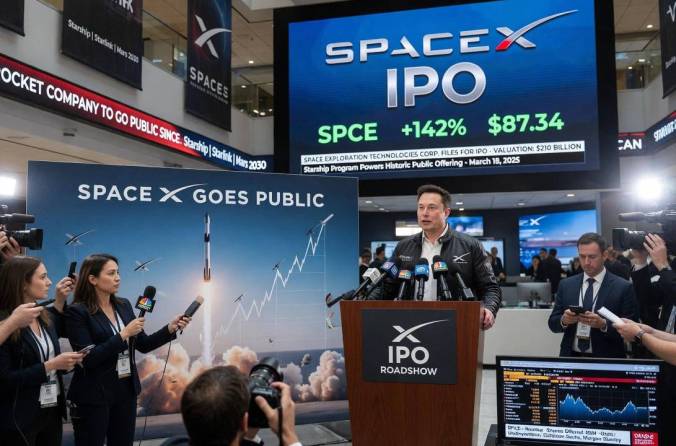
SpaceX IPO 2026: $1.75 Trillion Valuation for a Company with $4.9 Billion Annual Loss
Critical analysis reveals governance risks, unproven future technologies, and extreme valuation multiples – investors should look closer
Panama City, May 22nd 2026 – The planned public offering of SpaceX could be the largest IPO in history. With an intended valuation of $1.75 trillion and capital raising of approximately $75 billion, the company would surpass Saudi Aramco, the previous record holder, by a factor of four. However, an analysis of SpaceX’s SEC filings reveals a picture that contrasts sharply with the hype rhetoric surrounding the company.
The facts: SpaceX generated $18.7 billion in revenue in 2025 but simultaneously posted a net loss of $4.94 billion. In the first quarter of 2026, the situation worsened: the company reported a $4.28 billion loss on just $4.69 billion in revenue.
This is a company that is burning massive amounts of cash while expanding. This is not a growth story – this is a profitability problem.
Starlink finances everything else
The analysis shows: Starlink, the satellite internet business, accounts for roughly two-thirds of revenue and generates actual profits – $1.2 billion in the last quarter. All other business segments – Space Services and xAI – operate at losses.
In concrete terms: SpaceX is not the diversified aerospace company the stock market is buying. It is a satellite internet provider that is pouring billions into experimental technologies – financed by Starlink’s profits.
The Starship problem
SpaceX invested $3 billion in the Starship project in 2025 and an additional $930 million in the first quarter of 2026. Starship is the super-heavy rocket on which all major future plans are based – from the next generation of Starlink satellites to alleged AI data centers in orbit.
The problem: The planned Starship test flight on May 21, 2026 failed when a hydraulic pin did not retract as intended and multiple anomalies in fuel temperature and pressure occurred. The IPO prospectuses explicitly warn that technical setbacks or delays would have direct impacts on growth and competitiveness.
Translation: If Starship doesn’t work, the business model collapses.
Governance as a risk factor
The most critical problem lies in the company structure. Elon Musk controls 85.1 percent of voting rights through a dual-class share structure. This means: public investors do not buy a say – they buy Musk’s personal decisions.
The SEC documents explicitly list this as a risk factor: "Political controversies, conflicts of interest, and time management challenges" are identified as official dangers.
The hidden corporate governance reality: If Musk decides tomorrow to shift resources from Starship to xAI, minority shareholders can do nothing. If Musk’s public controversies damage SpaceX, investors can only watch.
The AI integration: Big money, minimal revenue
The AI segment (xAI/Grok) is growing at only 22 percent in revenue despite massive losses. For comparison: comparable AI companies show significantly higher growth curves.
SpaceX has essentially integrated xAI into the conglomerate – with investments in the billions of dollars. Grok, Musk’s AI assistant, is a byproduct of X (formerly Twitter). The hoped-for synergies have failed to materialize. xAI had to pay SpaceX $1.7 billion between January 2025 and February 2026 – a clear sign of dependence on the core business.
Valuation: 250x price-to-sales ratio
If SpaceX goes public at a $1.75 trillion valuation, that translates to a price-to-sales ratio of roughly 250 to 1. Highly-valued tech companies like Nvidia or Tesla operate at significantly lower multiples.
The message of the valuation is unmistakable: The market is not paying for current businesses. It is paying for an absolute bet on the future – that Starship works, that Starlink continues to grow exponentially, that AI data centers in orbit become a multi-trillion-dollar market, that Mars missions become profitable.
All of these assumptions must be correct. One of them has to fail, and the entire calculation collapses.
Conflicts of interest and hidden entanglements
The IPO documents reveal a complex network of conflicts of interest. Antonio Gracias, CEO of Valor Equity Partners and SpaceX board member, controls 7.3 percent of the company. His investment firm leases equipment to xAI worth approximately $20 billion – xAI has paid back $1.7 billion to these vertical structures.
These entanglements create not only conflicts of interest – they make independent audits substantially harder.
What works – what doesn’t
Starlink works: The business is growing, generating profits, and with 8.9 million users by the end of 2025 has genuine product-market fit.
SpaceX leads technologically: In the commercial space market, the company has a serious monopoly. Reusable rockets, booster landings, high launch frequency – competitors don’t have this.
But: Starship is not yet commercially operational. Orbital AI data centers are science fiction. Mars missions are decades away. And the cash burn of $5 billion per year is not yet controlled while the valuation climbs into double-digit trillions.
Critical questions for investors
1. When will SpaceX (overall, not just Starlink) turn profitable? The S-1 provides no answer.
2. What happens to the company if Musk takes a day off? The dual-class structure makes SpaceX a single point of failure.
3. How much is all this going to cost? If Starship costs another $10 billion, if xAI burns another $5 billion – who pays for it?
4. Is the valuation an investment or a speculation? With a P/S ratio of 250+, this is not an analysis of current assets but pure future speculation.
Conclusion: Technologically impressive, financially questionable
SpaceX is an extraordinary technological company. It has transformed the aerospace industry. Starlink is a functioning, growing business with genuine market potential. But the upcoming IPO is not the public listing of a profitable company – it is the redistribution of risk to public investors so that one individual can have unlimited funds for his experiments.
The question is not whether SpaceX can be technologically successful. The question is whether investors should pay $1.75 trillion to finance a company they cannot control, that is not profitable, and whose future is based on technologies that have yet to be proven.
This is critical journalism, not marketing spin. And this is exactly the question that should be asked before an IPO.
Sources
- IPO Prospectus S-1 (SEC Filing May 2026)
- TechSpot, TechCrunch, Fortune, NPR (May 2026)
- Bloomberg, Reuters, CNBC
- Ariva.de, IT-Boltwise.de, Investing.com